Rally Car (LEGO Technic 42077)
by ReDo.Bricks (@ReDo.Bricks)
Description
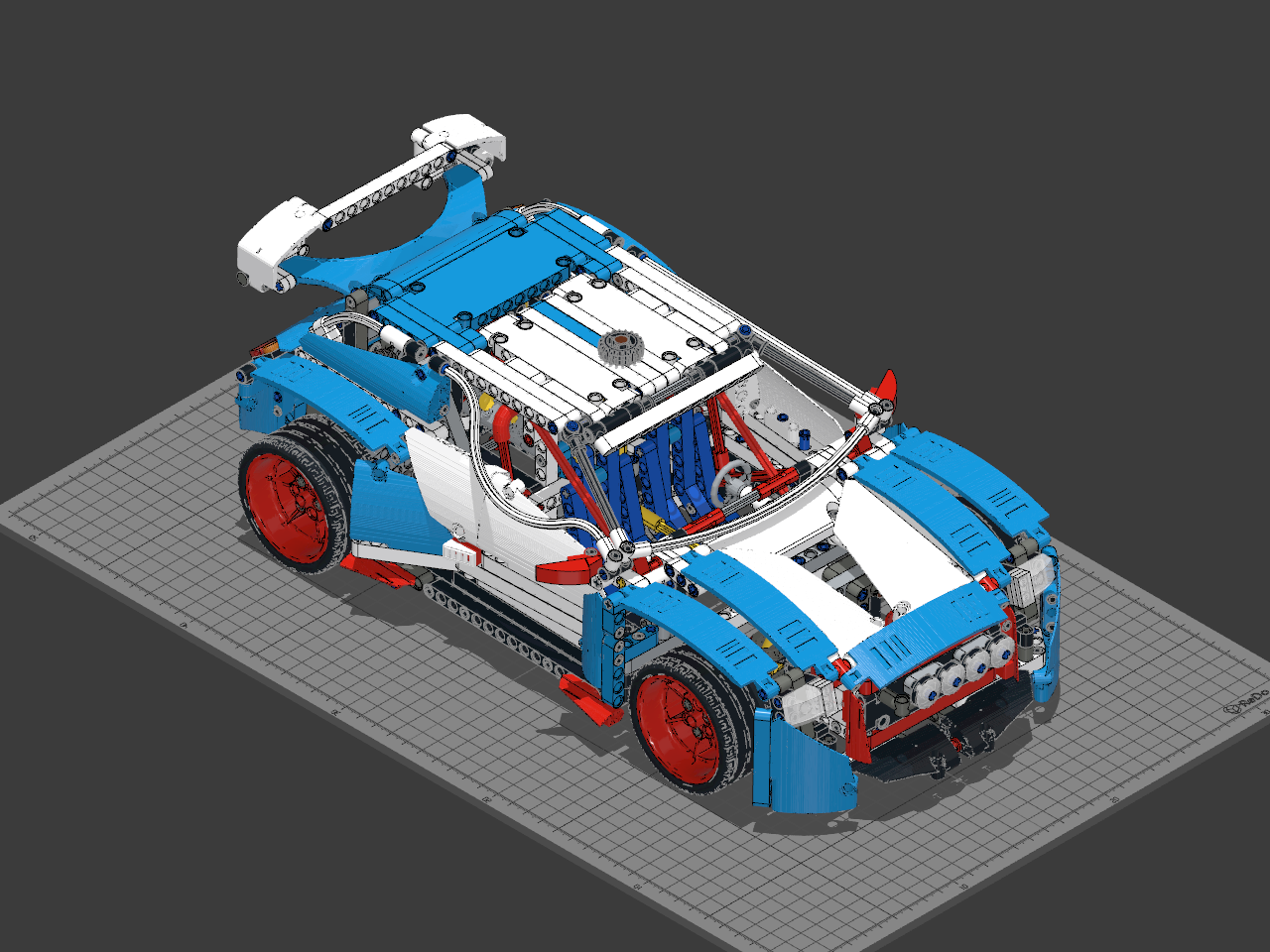
LEGO Technic set 42077, the Rally Car from 2018, built in ReDo from LEGO Technic parts by their part numbers: 1004 pieces, each one the real part in its real colour, every pin and axle joined into the holes it goes through as the set is built. The knob on the roof steers the front wheels through its bevel gears and the steering links, the rear wheels turn the engine's crankshaft and pistons through the differential, and the doors swing open on their hinge pins.
## Where it comes from
Each piece is placed where the LDraw community's model of the set puts it: *42077 - Rally Car* by Philippe Hurbain [Philo], from LDraw's Official Model Repository, redistributable under CCAL 2.0 (CC BY 2.0). The parts are ReDo's own parametric LEGO parts and meshes made from LDraw's drawings, not LEGO's CAD.
## What is different from the box
- Some pieces are built as LEGO's current mould of the same part: the black friction pins (2780) as 61332, the blue 3L pins (6558) as 42924, the pin connector hubs (15100, 87082) as 65487 and 44874, the towball pins (6628) as 66906, and the tan 3L pins without friction (32556) as 39888.
- The model leaves out a black pin the set has, placed here where LEGO's own booklet puts it: through the middle holes of the front axle's two white thin liftarms into the T-beam (step 101).
- The model paints two round pin connectors and the two ribbed hoses Metallic Silver; the set's are Flat Silver, as here.
- The model draws some gears tooth on tooth. Here the rear drive shaft's 20-tooth bevel and the steering knob's shaft with everything on it are turned half a tooth, so every pair, the steering pinion and its rack included, meshes tooth in gap.
- The ZR tyres are drawn 1.2 mm off the middle of their rims, so their beads miss the rims' flanges; they are centred on the rims, as the real tyres sit.
- Pieces the model draws a fraction of a millimetre into their neighbours, or off the holes they go through, are set where they belong: two pins 0.4 mm off their beam holes, two axle pins 0.8 mm too deep in their stop bushes, the right floor panel with its pins, beam and fairing (0.8 mm in from where the left one mirrors it), a 1 × 7 beam and the right rear fairing with its pin hub (each set where its left twin mirrors it), the two 2 × 2 plates with pin holes and the tiles on them (1.5 mm off their pins), two curved slopes sunk a plate's height into the plates that hold them, two axle pins rolled 3° across the cross of their axle holes, the left rear CV joint (square while its half shaft leans 13.6°), the front toggle joints (3.6° off the pin hole they close on), and the seats' Axle 3 (0.05 mm off the line of the beams it runs through).
- The front steering links stand over towballs 0.34 LDU further apart than their sockets; each is turned onto the line through both balls and set midway.
- Each door hangs on one long pin. The model swings them shut until their fairings cut 1.5 mm into the A-pillar's axle 10; here each stands 4° open on its hinge pin, where its fairing clears the axle and the rear fender.
- The rear wishbones are held by their pivot pins and a 1 × 7 strut each, so they do not swing, and the fender hinges at the other end of the rear links 1 × 6 cannot bring their towballs closer than 40.1 mm, while the links' sockets stand 40 mm apart and the model draws the balls 41.7 mm apart. Each link is set midway on the line through its two balls and recorded as a flex: the real link stretches over them.
- A few joints close in the real set only because the plastic gives, and are recorded as flexes: the seat backs' pins (0.95 mm off the double-bent beams' holes), the rear suspension links 1 × 16 and the shock bar's pins and connectors (0.2 to 0.8 mm), the front bumper's angled connectors on their pin hubs (0.65 mm), the notched axle in the rear crankshaft (0.05 mm), the rear links 1 × 6 (0.85 to 0.9 mm), the doors' fairings over the ends of the pins in the doors (0.8 mm), the hood's curved panel on the two small fairings at its front (0.85 and 0.9 mm), the hood's 1 × 13 beam against the connectors and the 1 × 9 beam it crosses (0.3 mm), the red 1 × 2 beams against the round pin connectors at the front (0.35 mm), and the engine's crankshaft and connecting rod on the axle with stop, whose end the model sets 0.8 mm past the crankshaft's axle hole. LEGO's booklet builds each of the last five as the model has it (the doors at steps 228 to 240, the hood panel at step 205, the engine at steps 38 to 43), so none is a fix to the model.
- Where a flex is a pin in its hole or a towball in its socket, it stands in for that joint, held where the model draws it, so the whole car is one piece: the two rear links 1 × 6, the two rear suspension links 1 × 16 with their pin hubs, and the shock bar's axle and connectors with the pins the links hang on hold to it, in a drag and in Simulation.
- A few faces LDraw draws touching come out a few hundredths to a tenth of a millimetre into each other in ReDo's meshes: the bumper's angled connectors side by side, the differential's 12-tooth bevels in its cage, the rear bent beams on their L-beams, the front pin hubs on their 1 × 3 beams, two half pins end to end with pins, and the left door's long fairing against the pin beside it. They are recorded as flexes too, until those meshes are made closer.
- The parts leave out what does not change how they fit: the hollows under a beam, the engine's moulded detail, the tyres' tread pattern.
## Try it
Turn the knob on the roof in Simulation to steer the front wheels, open a door, or select any piece to see its part number.
Bill of materials
- 10 × Technic Beam 1 × 13 Thick
- 186 × Technic Pin with Friction Ridges Lengthwise with No Center Slots
- 119 × Technic Pin Long with Friction Ridges Lengthwise, 1 Center Slot
- 31 × Technic Pin Long with Friction Ridges Lengthwise and Stop Bush [3 Lateral Holes, Big Pin Hole]
- 41 × Technic Axle Pin with Friction Ridges Lengthwise
- 10 × Technic Beam 1 × 15 Thick
- 2 × Technic Beam 5 × 11 with 3 × 5 Opening Frame Thick
- 12 × Technic Axle 5
- 15 × Technic Pin Connector Round [Slotted]
- 2 × Technic Axle 7
- 3 × Technic Panel 5 × 11 × 1
- 16 × Technic Beam 1 × 5 Thick
- 3 × Technic Panel Fairing #22 5L Small Smooth, Side A
- 3 × Technic Panel Fairing #21 5L Small Smooth, Side B
- 4 × Technic Beam Frame 5 × 7 with 3 × 5 Opening Thick
- 3 × Technic Axle 4 with Centre Stop
- 2 × Technic Gear 20 Tooth Double Bevel with Axle Hole Type 2 [X Opening]
- 1 × Technic Gear Differential with Inner Tabs and Closed Center, 28 Bevel Teeth [Beveled Edge]
- 4 × Technic Gear 12 Tooth Bevel
- 2 × Technic Steering / CV Joint Axle
- 9 × Technic Axle and Pin Connector Perpendicular Triple
- 4 × Technic Steering / CV Joint
- 3 × Technic Axle 4
- 4 × Technic Steering Hub for Portal Axle
- 2 × Technic Steering Portal with 2 Pin Holes
- 4 × Technic Pin Long without Friction Ridges, with Anti-Roll Notch
- 23 × Technic Beam 1 × 7 Thick
- 23 × Technic Axle and Pin Connector Perpendicular
- 4 × Technic Shock Absorber 6.5L Cylinder
- 4 × Technic Shock Absorber 6.5L Piston Rod
- 4 × Technic Shock Absorber 6.5L Spring, Tight Coil in Middle [Hard]
- 2 × Technic Pin Connector Block 1 × 5 × 3
- 6 × Technic Engine Cylinder without Side Slots, with Bottom Slots
- 2 × Technic Engine Crankshaft
- 6 × Technic Engine Connecting Rod
- 6 × Technic Engine Piston Round
- 2 × Technic Engine Crankshaft Center
- 8 × Technic Axle 2 Notched
- 16 × Technic Axle 3
- 12 × Technic Axle and Pin Connector Angled #1
- 1 × Technic Axle 5.5 with Stop
- 5 × Technic Axle Connector Smooth [with x Hole + Orientation]
- 2 × Technic Gear 12 Tooth Double Bevel
- 34 × Technic Pin Connector Hub with 1 Pin with Friction Ridges Lengthwise [Centered Friction Ridge]
- 5 × Technic Pin Connector Hub with 2 Pins with Friction Ridges Lengthwise [Small Squared Pin Holes]
- 10 × Technic Pin Connector Round 1L [Beam]
- 10 × Technic Beam 1 × 3 Thick
- 2 × Technic Beam 1 × 7 Bent (4 - 4) Thick
- 4 × Technic Pin Connector Hub with 1 Axle
- 12 × Technic Pin with Friction Ridges Lengthwise and Towball - Round Pin Hole
- 7 × Technic Beam 1 × 9 Thick
- 16 × Technic Beam 3 × 5 L-Shape Thick
- 4 × Technic Axle and Pin Connector Perpendicular Double Split
- 4 × Technic Link 1 × 16
- 2 × Technic Beam Triangle Thin
- 6 × Technic Beam 1 × 2 Thick
- 8 × Technic Axle and Pin Connector Angled #6 - 90°
- 3 × Technic Panel Curved 11 × 3 with 2 Pin Holes through Panel Surface
- 2 × Hose, Ribbed 7mm D. 11L / 8.8cm
- 1 × Technic Pin Connector Toggle Joint Smooth Double with Axle and Pin Holes
- 2 × Technic Beam 3 × 3 T-Shape Thick
- 6 × Technic Axle 4 with Stop
- 1 × Technic Gear 20 Tooth Bevel
- 6 × Technic Beam 1 × 11.5 Double Bent Thick
- 13 × Technic Beam 1 × 11 Thick
- 1 × Technic Axle 11
- 4 × Technic Panel Fairing #13 Large Short Smooth, Side A
- 4 × Technic Beam 1 × 9 Bent (7 - 3) Thick
- 9 × Technic Axle 3 with Stop
- 4 × Technic Link 1 × 6 without Stoppers
- 4 × Technic Panel Fairing #14 Large Short Smooth, Side B
- 8 × Technic Bush
- 4 × Technic Beam 1 × 9 Bent (6 - 4) Thick
- 14 × Technic Beam 2 × 4 L-Shape Thick
- 11 × Technic Axle Pin 3L with Friction Ridges Lengthwise and 1L Axle
- 4 × Brick Round 1 × 1 diameter Tube with 90 Degree Elbow (2 × 2 × 1) and Axle Holes (Crossholes) at each end
- 4 × Technic Axle 10
- 4 × Technic Steering Arm 5.5 × 2 with Towball Socket Rounded, Chamfered
- 12 × Technic Bush 1/2 Smooth with Axle Hole Semi-Reduced
- 2 × Technic Axle 5 with Stop
- 10 × Technic Beam 1 × 3 Thin
- 7 × Technic Axle and Pin Connector Perpendicular 3L with 2 Pin Holes
- 2 × Technic Steering Wheel Hub Holder with 2 Pin Holes and 2 Axle Holes, Slots
- 2 × Technic Axle Towball
- 4 × Technic Beam 1 × 5 Thin with Axle Holes on Ends
- 1 × Technic Gear Rack 1 × 7 with Axle and Pin Holes
- 8 × Technic Pin 1/2 without Friction Ridges
- 4 × Tile Round 1 × 1
- 1 × Technic Steering Wheel Small (3 Studs Diameter)
- 3 × Brick Round 2 × 2 with Axle Hole
- 1 × Brick Round 2 × 2 Dome Top, Hollow Stud
- 1 × Tap 1 × 1 without Hole in Spout
- 2 × Technic Axle and Pin Connector Perpendicular 3L with Centre Pin Hole
- 1 × Technic Axle 9
- 3 × Technic Panel Fairing # 3 Small Smooth Long, Side A
- 3 × Technic Panel Fairing # 4 Small Smooth Long, Side B
- 1 × Technic Beam 3 × 5 Thick [90° Offset Centre Beam Holes]
- 2 × Wheel 31 × 15 Technic, 7 Pin Holes
- 2 × Jet Engine Fan with 10 Blades and Technic Pin
- 4 × Technic Brick 1 × 2 with 2 Pin Holes
- 2 × Brick Curved 2 × 2 with Lip, No Studs
- 4 × Plate 1 × 2
- 4 × Tile 1 × 2
- 2 × Technic Axle and Pin Connector Perpendicular Double
- 4 × Technic Panel 3 × 11 × 1
- 4 × Plate Round 2 × 2 with Axle Hole Type 1 (+ Opening)
- 4 × Plate Round 2 × 2 with Rounded Bottom [Boat Stud]
- 6 × Technic Axle 8
- 2 × Technic Driving Ring Connector Smooth [4 rounded side walls]
- 7 × Technic Panel Curved 3 × 13
- 2 × Technic Panel Fairing #18 Large Smooth, Side B
- 2 × Technic Panel Fairing #17 Large Smooth, Side A
- 4 × Plate Special 1 × 2 with Pin Hole Underneath
- 2 × Slope 30° 1 × 1 × 2/3 (Cheese Slope)
- 2 × Brick Curved 3 × 1 No Studs
- 4 × Technic Axle and Pin Connector Toggle Joint Smooth
- 3 × Axle Hose, Soft 19L
- 2 × Slope 18° 2 × 1 × 2/3 with 4 Slots / Grate
- 2 × Plate Special 2 × 2 with 2 Pin Holes
- 4 × Technic Panel Curved and Bent 6 × 3
- 2 × Technic Beam 1 × 2 Thick with Pin Hole and Axle Hole
- 2 × Axle Hose, Soft 7L
- 1 × Technic Panel Fairing #6 Long Smooth, Side B
- 1 × Technic Panel Fairing #5 Long Smooth, Side A
- 1 × Technic Panel Curved 7 × 3 with 2 Pin Holes through Panel Surface
- 1 × Technic Panel Car Mudguard Arched 15 × 2 × 5
- 4 × Wheel 56 × 34 Technic Racing Medium with 6 Pin Holes
- 4 × Tyre 68.8 × 36 ZR
Licences
- Technic Beam: CC BY-SA 4.0, credit ReDo.Pro. Downloads: STEP, STL and 3MF
- Technic Pin: CC BY-SA 4.0, credit ReDo.Pro. Downloads: STEP, STL and 3MF
- LEGO Technic Beam 5 x 11 with 3 x 5 Opening Frame Thick (64178): CC BY 4.0, credit LEGO. Downloads: STEP, STL and 3MF
- Technic Axle: CC BY-SA 4.0, credit ReDo.Pro. Downloads: STEP, STL and 3MF
- Technic Connector: CC BY-SA 4.0, credit ReDo.Pro. Downloads: STEP, STL and 3MF
- Technic Flat Panel: CC BY-SA 4.0, credit ReDo.Pro. Downloads: STEP, STL and 3MF
- LEGO Technic Panel Fairing #22 5L Small Smooth, Side A (11947): CC BY 4.0, credit LEGO. Downloads: STEP, STL and 3MF
- LEGO Technic Panel Fairing #21 5L Small Smooth, Side B (11946): CC BY 4.0, credit LEGO. Downloads: STEP, STL and 3MF
- LEGO Technic Beam Frame 5 x 7 with 3 x 5 Opening Thick (64179): CC BY 4.0, credit LEGO. Downloads: STEP, STL and 3MF
- Technic Double Bevel Gear: CC BY-SA 4.0, credit ReDo.Pro. Downloads: STEP, STL and 3MF
- LEGO Technic Gear Differential with Inner Tabs and Closed Center, 28 Bevel Teeth [Beveled Edge] (62821b): CC BY 4.0, credit LEGO. Downloads: STEP, STL and 3MF
- Technic Bevel Gear: CC BY-SA 4.0, credit ReDo.Pro. Downloads: STEP, STL and 3MF
- LEGO Technic Steering / CV Joint Axle (92906): CC BY 4.0, credit LEGO. Downloads: STEP, STL and 3MF
- Technic Cross Block: CC BY-SA 4.0, credit ReDo.Pro. Downloads: STEP, STL and 3MF
- LEGO Technic Steering / CV Joint (32494): CC BY 4.0, credit LEGO. Downloads: STEP, STL and 3MF
- LEGO Technic Steering Hub for Portal Axle (92909): CC BY 4.0, credit LEGO. Downloads: STEP, STL and 3MF
- LEGO Technic Steering Portal with 2 Pin Holes (11950): CC BY 4.0, credit LEGO. Downloads: STEP, STL and 3MF
- Technic Shock Absorber: CC BY-SA 4.0, credit ReDo.Pro. Downloads: STEP, STL and 3MF
- Technic Shock Absorber Spring: CC BY-SA 4.0, credit ReDo.Pro. Downloads: STEP, STL and 3MF
- LEGO Technic Pin Connector Block 1 x 5 x 3 (32333): CC BY 4.0, credit LEGO. Downloads: STEP, STL and 3MF
- LEGO Technic Engine Cylinder Without Side Slots, with Bottom Slots (2850b): CC BY 4.0, credit LEGO. Downloads: STEP, STL and 3MF
- LEGO Technic Engine Crankshaft (2853): CC BY 4.0, credit LEGO. Downloads: STEP, STL and 3MF
- LEGO Technic Engine Connecting Rod (2852): CC BY 4.0, credit LEGO. Downloads: STEP, STL and 3MF
- LEGO Technic Engine Piston Round (2851): CC BY 4.0, credit LEGO. Downloads: STEP, STL and 3MF
- LEGO Technic Engine Crankshaft Center (2854): CC BY 4.0, credit LEGO. Downloads: STEP, STL and 3MF
- Technic Towball: CC BY-SA 4.0, credit ReDo.Pro. Downloads: STEP, STL and 3MF
- LEGO Technic Link 1 x 16 (2637): CC BY 4.0, credit LEGO. Downloads: STEP, STL and 3MF
- Technic Panel Curved 11 × 3 with 2 Pin Holes Through Panel Surface (62531): CC BY-SA 4.0, credit ReDo.Pro. Downloads: STEP, STL and 3MF
- Rigid Hose: CC BY-SA 4.0, credit ReDo.Pro. Downloads: STEP, STL and 3MF
- LEGO Technic Pin Connector Toggle Joint Smooth Double with Axle and Pin Holes (87408): CC BY 4.0, credit LEGO. Downloads: STEP, STL and 3MF
- LEGO Technic Panel Fairing #13 Large Short Smooth, Side A (64394): CC BY 4.0, credit LEGO. Downloads: STEP, STL and 3MF
- LEGO Technic Link 1 x 6 Without Stoppers (32005a): CC BY 4.0, credit LEGO. Downloads: STEP, STL and 3MF
- LEGO Technic Panel Fairing #14 Large Short Smooth, Side B (64680): CC BY 4.0, credit LEGO. Downloads: STEP, STL and 3MF
- Technic Bush: CC BY-SA 4.0, credit ReDo.Pro. Downloads: STEP, STL and 3MF
- LEGO Brick Round 1 x 1 Diameter Tube with 90 Degree Elbow (2 x 2 x 1) and Axle Holes (Crossholes) at Each End (25214): CC BY 4.0, credit LEGO. Downloads: STEP, STL and 3MF
- LEGO Technic Steering Arm 5.5 x 2 with Towball Socket Rounded, Chamfered (57515): CC BY 4.0, credit LEGO. Downloads: STEP, STL and 3MF
- LEGO Technic Steering Wheel Hub Holder with 2 Pin Holes and 2 Axle Holes, Slots (23801): CC BY 4.0, credit LEGO. Downloads: STEP, STL and 3MF
- Technic Gear Rack 1 × 7: CC BY-SA 4.0, credit ReDo.Pro. Downloads: STEP, STL and 3MF
- Round Tile: CC BY-SA 4.0, credit ReDo.Pro. Downloads: STEP, STL and 3MF
- LEGO Technic Steering Wheel Small (3 Studs Diameter) (2819): CC BY 4.0, credit LEGO. Downloads: STEP, STL and 3MF
- Round Brick: CC BY-SA 4.0, credit ReDo.Pro. Downloads: STEP, STL and 3MF
- LEGO Brick Round 2 x 2 Dome Top, Hollow Stud (30367c): CC BY 4.0, credit LEGO. Downloads: STEP, STL and 3MF
- Tap: CC BY-SA 4.0, credit ReDo.Pro. Downloads: STEP, STL and 3MF
- LEGO Technic Panel Fairing # 3 Small Smooth Long, Side A (64683): CC BY 4.0, credit LEGO. Downloads: STEP, STL and 3MF
- LEGO Technic Panel Fairing # 4 Small Smooth Long, Side B (64391): CC BY 4.0, credit LEGO. Downloads: STEP, STL and 3MF
- LEGO Technic Beam 3 x 5 Thick [90° Offset Centre Beam Holes] (14720): CC BY 4.0, credit LEGO. Downloads: STEP, STL and 3MF
- LEGO Wheel 31 x 15 Technic, 7 Pin Holes (60208): CC BY 4.0, credit LEGO. Downloads: STEP, STL and 3MF
- LEGO Jet Engine Fan with 10 Blades and Technic Pin (46667): CC BY 4.0, credit LEGO. Downloads: STEP, STL and 3MF
- Technic Brick: CC BY-SA 4.0, credit ReDo.Pro. Downloads: STEP, STL and 3MF
- LEGO Brick Curved 2 x 2 with Lip, No Studs (30602): CC BY 4.0, credit LEGO. Downloads: STEP, STL and 3MF
- LEGO Plate: CC BY-SA 4.0, credit ReDo.Pro. Downloads: STEP, STL and 3MF
- Tile: CC BY-SA 4.0, credit ReDo.Pro. Downloads: STEP, STL and 3MF
- Round Plate: CC BY-SA 4.0, credit ReDo.Pro. Downloads: STEP, STL and 3MF
- LEGO Plate Round 2 x 2 with Rounded Bottom [Boat Stud] (2654): CC BY 4.0, credit LEGO. Downloads: STEP, STL and 3MF
- Technic Driving Ring Connector: CC BY-SA 4.0, credit ReDo.Pro. Downloads: STEP, STL and 3MF
- LEGO Technic Panel Curved 3 x 13 (18944): CC BY 4.0, credit LEGO. Downloads: STEP, STL and 3MF
- LEGO Technic Panel Fairing #18 Large Smooth, Side B (64682): CC BY 4.0, credit LEGO. Downloads: STEP, STL and 3MF
- LEGO Technic Panel Fairing #17 Large Smooth, Side A (64392): CC BY 4.0, credit LEGO. Downloads: STEP, STL and 3MF
- LEGO Plate Special 1 x 2 with Pin Hole Underneath (18677): CC BY 4.0, credit LEGO. Downloads: STEP, STL and 3MF
- Slope: CC BY-SA 4.0, credit ReDo.Pro. Downloads: STEP, STL and 3MF
- Curved Slope: CC BY-SA 4.0, credit ReDo.Pro. Downloads: STEP, STL and 3MF
- LEGO Brick Sloped 18° 2 x 1 x 2/3 with 4 Slots / Grate (61409): CC BY 4.0, credit LEGO. Downloads: STEP, STL and 3MF
- Pin Hole Plate: CC BY-SA 4.0, credit ReDo.Pro. Downloads: STEP, STL and 3MF
- LEGO Technic Panel Curved and Bent 6 x 3 (24116): CC BY 4.0, credit LEGO. Downloads: STEP, STL and 3MF
- LEGO Technic Panel Fairing #6 Long Smooth, Side B (64393): CC BY 4.0, credit LEGO. Downloads: STEP, STL and 3MF
- LEGO Technic Panel Fairing #5 Long Smooth, Side A (64681): CC BY 4.0, credit LEGO. Downloads: STEP, STL and 3MF
- Technic Panel Curved 7 × 3 with 2 Pin Holes Through Panel Surface (24119): CC BY-SA 4.0, credit ReDo.Pro. Downloads: STEP, STL and 3MF
- LEGO Technic Panel Car Mudguard Arched 15 x 2 x 5 (24118): CC BY 4.0, credit LEGO. Downloads: STEP, STL and 3MF
- LEGO Wheel 56 x 34 Technic Racing Medium with 6 Pin Holes (15038): CC BY 4.0, credit LEGO. Downloads: STEP, STL and 3MF
- LEGO Tyre 68.8 x 36 ZR (44771): CC BY 4.0, credit LEGO. Downloads: STEP, STL and 3MF