One chamfer: 0.5 mm
Every outside edge of a ReDo part is broken by a small slope, 0.5 mm (CHAMFER): from the Block down to the tip of a screw. It feels better in the hand, prints cleaner and does not chip.
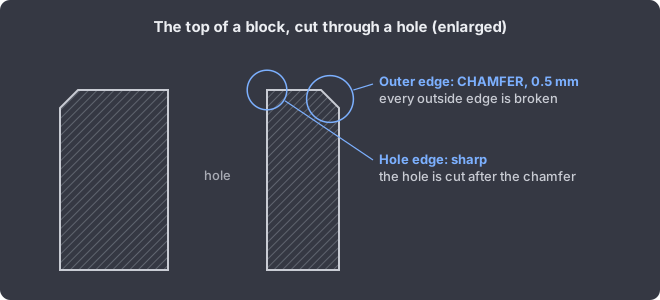
Holes stay sharp
The chamfer is made first and the holes are cut after, so the holes keep sharp edges and a screw head sits flat. In ReDo.Core:
include <redo_constants.scad>

difference() {
    chamfer(CHAMFER) cube([span(2), span(1), span(1)]);
    translate([hole_at(0), hole_at(0), 0]) hole(SCREW_HOLE_D);
    translate([hole_at(1), hole_at(0), 0]) hole(SCREW_HOLE_D);
}
Some edges stay square
- Where two printed parts meet, such as a case and its lid, those faces have no chamfer, or the joint would show a groove.
- Only the edges a part shows are broken. A screw breaks only its tip; a spacer only its outside.
Round corners
A plate's corners are rounded to 5 mm (CORNER_R), half a cell, so a corner hole sits at the centre of its corner's curve. Untick rounded for square corners.