One screw size: M3
Every ReDo part takes M3 screws, wherever its walls are thick enough. One size of screw, nut and spacer builds everything. A smaller screw is used only where nothing else fits, such as the lid of a micro servo case.
Two hole sizes
The two holes look the same on screen, but they do different jobs:
| Hole | Size | What the screw does | Found in |
|---|---|---|---|
| Threaded | 2.75 mm (SCREW_HOLE_D) | Cuts its thread into the plastic and holds | Blocks, cases, anything something is fastened to |
| Through | 3 mm (THRU_HOLE_D) | Passes through freely | Plates, brackets, spacers, anything held by the screw |
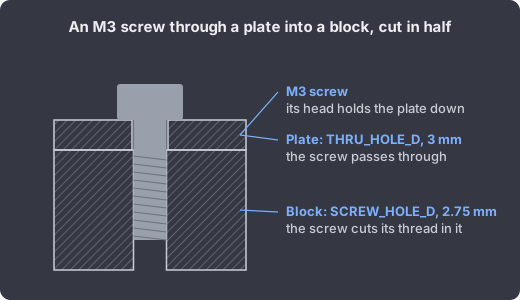
So a joint is always a through part on top of a threaded part: the screw head holds the plate, and the block holds the screw. Use the wrong one and the screw either strips the hole or will not grip.
Some parts let you choose. A Plate, for example, has a hole type: through, countersunk on the top, the bottom or both, or threaded.
Countersunk holes
A countersunk hole has a cone at its mouth, 6 mm across (CSK_D), so a countersunk screw's head sits flush with the face.
In the Playground
A threaded hole joins a screw as Fixed: the parts move as one. A through hole lets a rod or pin turn and slide in it. See Assembly Mode.
include <redo_constants.scad>

difference() {
    cube([span(2), span(1), span(1)]);
    translate([hole_at(0), hole_at(0), 0]) hole(SCREW_HOLE_D);
    translate([hole_at(1), hole_at(0), 0]) hole(SCREW_HOLE_D);
}